Nova Orchard
by ZokoGames Studio
Play nowStarts in your browserNo download needed
Nova Orchard
Slide the night sky: equal stars merge and grow from sparks to comets, moons, suns and novas. Classic boards, a daily sky and 36 puzzles.
- Works on phone
- Saves progress
- Released
- Version 1
- Works on
- Browser (desktop, mobile, tablet)
Nova Orchard game guide
How to play Nova Orchard
- Keyboard and mouse
- Touch
- Choose Classic, Daily sky or Puzzles.
- Slide in any direction to move every star at once.
- Merge equal stars to grow them into the next stage.
- Keep moves open: the game ends when no slide changes the board.
Controls
- Touch / mouse: swipe or drag across the board in any direction. A direction pad can be switched on in Settings.
- Keyboard: ←↑↓→ or WASD slide; U, Z or Backspace undoes; H shows a hint; G reads the board out.
- P / ESC: pause, M: mute
Accessibility
- Each move is announced to screen readers, for example the number of merges, where the new star appeared and the score.
- Read board lists every row as text.
- Settings offer large numbers, a high-contrast theme, reduced motion, vibration on or off and the direction pad.
Nova Orchard tips and strategy
- Pick one corner for your biggest star and never leave it. Slide mostly in the two directions that push toward that corner, and use a third direction only when you must.
- Keep the edge row full. If the row along your corner has no gaps, an awkward slide cannot drag the big star away from the corner.
- Build a falling chain along the edge. Values like 64, 32, 16 and 8 in a row let one slide merge the whole chain, because the stars nearest the edge you slide toward merge first.
- Count merges before you slide. A star merges only once per move, so a row of four equal stars becomes two new stars, not one. Plan so that the results line up for the next move.
- Break shadow stones early. A stone blocks merges across it and cracks only when a merge lands right next to it, with the second crack breaking it. Merge beside it while it is near an edge, before it drifts into the middle.
- In puzzles, think before the first move. No new stars fall, so every star you need is already on the board. Work out the merges to the goal within the move limit, and use unlimited undo to test lines. Three stars need the fewest possible moves.
- Use the Daily sky for a clean first attempt. Only your first attempt counts for the streak, and the stars fall the same for everyone. Replay it as practice to try other openings, and use a free hint when you are stuck.
About Nova Orchard
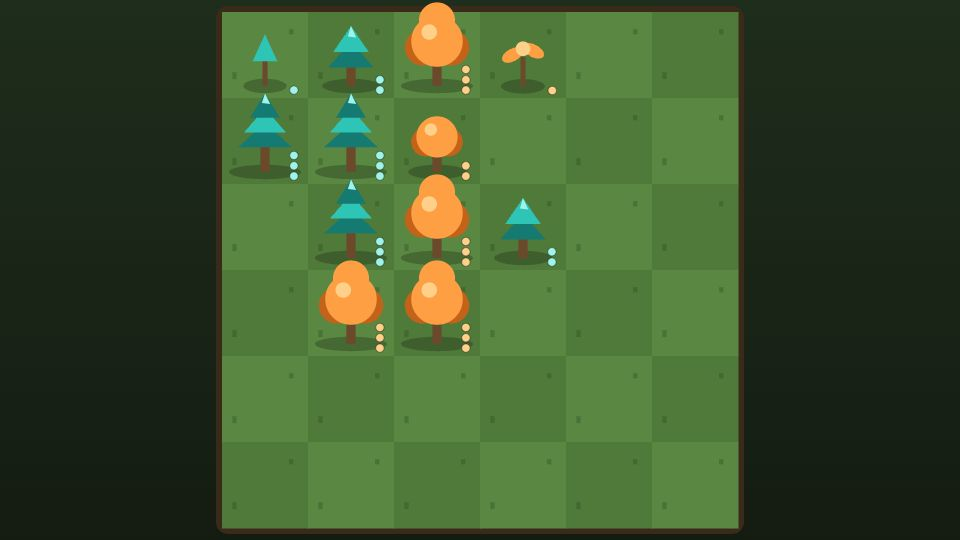
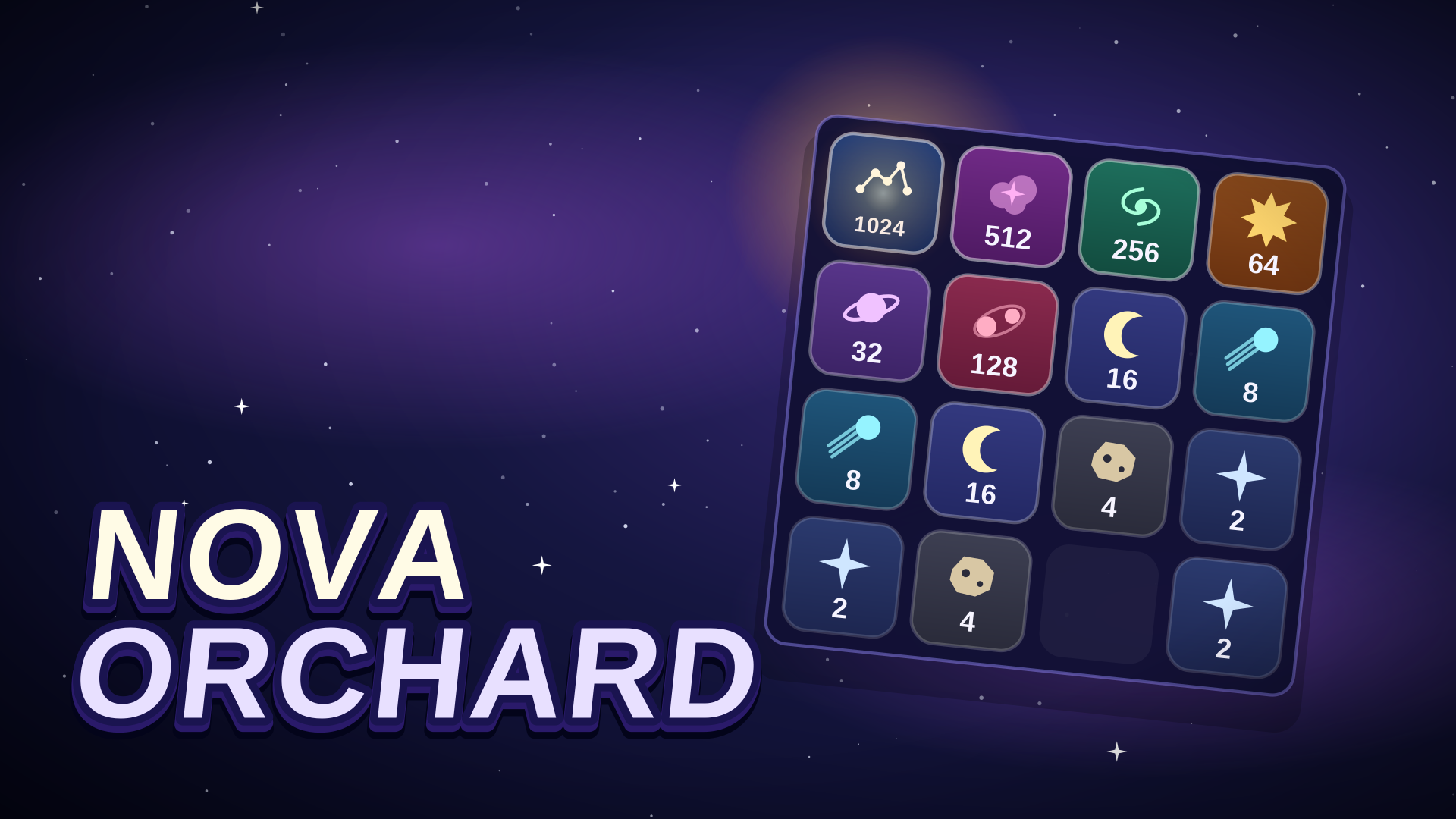
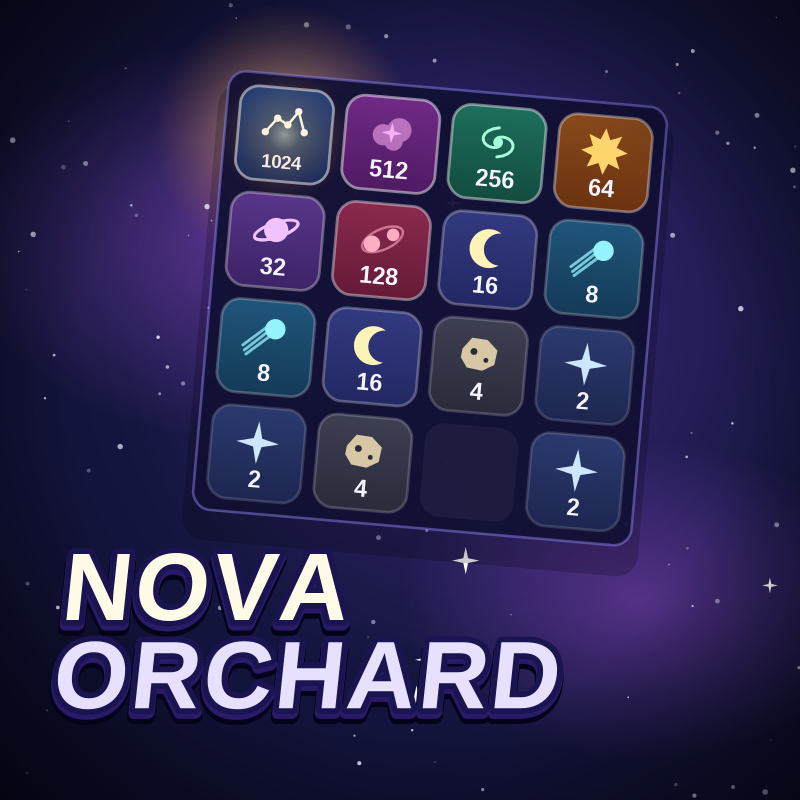
Nova Orchard is a sliding merge puzzle set in a night-sky orchard. Every move slides all the stars on the board as far as they can go. When two equal stars meet, they merge into one star of double the value and grow into the next stage: a spark becomes a pebble, then a comet, a moon, a ringed world, a sun, twin suns, a spiral, a nebula, a constellation, a nova and an eclipse. Every star shows its number as well as its own shape, so you can read the board without relying on colour.
After each move one new star appears in an empty cell, usually a 2 and sometimes a 4. A move that changes nothing does not count and adds nothing. A star can merge only once per move, and the stars nearest the edge you slide toward merge first. The game ends when no slide can change the board. Reach the bloom star (2,048 on 4 × 4, 4,096 on 5 × 5 and 8,192 on 6 × 6) for a celebration, then keep growing as far as you can.
Modes
- Classic: 4 × 4, 5 × 5 or 6 × 6, each with its own best score and its own saved game.
- Daily sky: a 5 × 5 sky with the same sequence of new stars for every player on the same UTC date. It has a par score, and your first attempt each day counts for your daily streak and calendar. Replays are practice with unlimited undo.
- Puzzles: 36 fixed starting boards where no new stars fall. Make the goal star within the move limit. Each puzzle is checked to be solvable, and solving it in the fewest possible moves earns three stars.
Shadow stones
On 5 × 5, 6 × 6 and in the Daily sky, a shadow stone appears now and then, and some puzzles start with one. A stone slides like a star but never merges, and stars cannot merge across it. Each merge that lands right next to a stone cracks it, and the second crack breaks it. You can switch stones off for Classic in Settings.
Scoring
Each merge scores the value of the new star, so merging two 8s into a 16 scores 16. Hints are free and only counted in your statistics.
Tips and strategy
- Pick a corner for your biggest star and keep it there. Slide mostly in two directions that push toward that corner.
- Keep the row along that corner full so a stray slide cannot pull your big star out.
- Build a chain of falling values along the edge (64, 32, 16, 8) so one slide can merge them all at once.
- Break stones early by merging next to them before they drift into the middle of the board.
- In puzzles, count your merges before you move: every star you need is already on the board.
Details
- Technology
- HTML5
- Orientation
- Landscape or portrait
- Languages
- English
- Features
- Saves progress · Works on iPhone and iPad
- Controls
- ←
- ↑
- ↓
- →
- W
- A
- S
- D
Nova Orchard features
- Twelve star shapes. Stars grow from a spark through a pebble, comet, moon, ringed world, sun, twin suns, spiral, nebula, constellation and nova to an eclipse. Every star also shows its number.
- Three Classic boards. 4 x 4, 5 x 5 and 6 x 6 each have their own best score and saved game, with bloom stars at 2,048, 4,096 and 8,192.
- Daily sky. A 5 x 5 board where the new stars come from the UTC date, so everyone gets the same sequence. It has a par score, a streak and a calendar of the last five weeks.
- 36 puzzles. Fixed starting boards with no new stars, a goal star and a move limit. Each was checked by a solver, and the fewest moves earn three stars.
- Shadow stones. On 5 x 5, 6 x 6 and in the Daily sky, a stone that never merges can appear. It cracks twice from nearby merges and then breaks. Classic can switch stones off.
- Hints and undo. A free hint suggests a slide using a look-ahead search. Classic can undo the last move, and practice and puzzles have unlimited undo.
- Statistics. Skies played, moves, merges, best star, best score per board, daily streak, hints used, puzzles solved and stones broken.
- Accessibility settings. Large numbers, a high-contrast theme, reduced motion, vibration on or off and an on-screen direction pad. Moves are announced to screen readers, and Read board lists the grid as text.
- Plays offline. Works in portrait and landscape, with swipe, keyboard or direction pad, and every mode keeps its own saved game.
Questions about Nova Orchard
How is this different from other sliding merge games?
The stars grow through twelve shapes as they merge, so the board reads by shape and number. There is a Daily sky that is the same for everyone, 36 fixed puzzles with move limits, and optional shadow stones that only break when merges happen next to them.
Is the Daily sky really the same for everyone?
Yes. The new stars come from a sequence seeded by the UTC date, so the same moves give the same board for every player that day. Your first attempt counts for your streak; replays are practice.
Can I undo a move?
In Classic you can take back the last move, or switch undo off in Settings. Daily practice and Puzzles allow unlimited undo. When a Classic sky fills up you can take back three moves once.
Are all puzzles solvable?
Yes. Every puzzle was checked by a solver that uses the same rules as the game, and its fewest possible moves are its par for three stars.
Is my game saved?
Yes. Each mode keeps its own game in progress, along with your settings, best scores, streak and statistics. Choose Continue in the menu to pick up where you left off.
Can I play with a screen reader?
Yes. Every move is announced, Read board lists the whole grid row by row, and the game can be played entirely with the keyboard.
Updates
Version 1Live now
Every update passes our automatic build checks before it goes live.
Play on your phone
Point your phone camera at the code to open this game there.