Tidemark Backgammon
by ZokoGames Studio
Play nowStarts in your browserNo download needed
Tidemark Backgammon
Backgammon with the full rules against a four-level computer or a friend on the same device: doubling cube, match play with the Crawford rule, hints and fair dice.
- Works on phone
- Saves progress
- Released
- Version 1
- Works on
- Browser (desktop, mobile, tablet)
Tidemark Backgammon game guide
How to play Tidemark Backgammon
- Keyboard and mouse
- Touch
- Choose your opponent, the computer's level, single games or a match, and whether to use the doubling cube.
- Roll the dice (or double the stakes first, when the cube is on).
- Tap a checker, then one of the lit points. A checker can move with one die or with both in a row. Drag a checker if you prefer.
- Undo any move of the turn, then confirm. The other side plays next.
Controls
- Mouse / touch: tap a checker, then a lit point or the tray to bear off; tap the dice to roll or confirm
- Keyboard: ←↑↓→ choose a checker and then a destination, Enter or Space moves, Backspace cancels
- R: roll, C: confirm, U: undo, H: hint, D: double, F: flip the board
- P / ESC: pause, M: mute
Tidemark Backgammon tips and strategy
- Make points early. Two checkers on one point are safe and block your opponent. Your 5, 4 and 7 points matter most, because they stand in the way of the checkers still to come around.
- Count before you leave a blot. A single checker within six points in front of an opposing checker is hit far more often than one further away. Use the pip counts and the hint to see what a risk costs.
- Build a prime. Several made points in a row cannot be jumped. Six in a row cannot be passed at all, so trap the checkers you have hit behind one.
- Hit when it hurts. Sending a checker to the bar costs your opponent the pips it had travelled, and a checker on the bar must enter before anything else moves. Hit most when your opponent has several points of yours to avoid.
- Run when the race is yours. Once the checkers have passed each other the game is a pure race. Compare the pip counts and stop taking risks if you are ahead.
- Think before you double. Double when you are clearly ahead but your opponent still has a real chance. Take a double when you would win at least one game in four. In a match, the Crawford game is played without the cube.
- Learn from the hint. The hint shows the move the Expert level would play. Try your own move first, then compare, and move up a level when you can win a match at the one you are on.
About Tidemark Backgammon
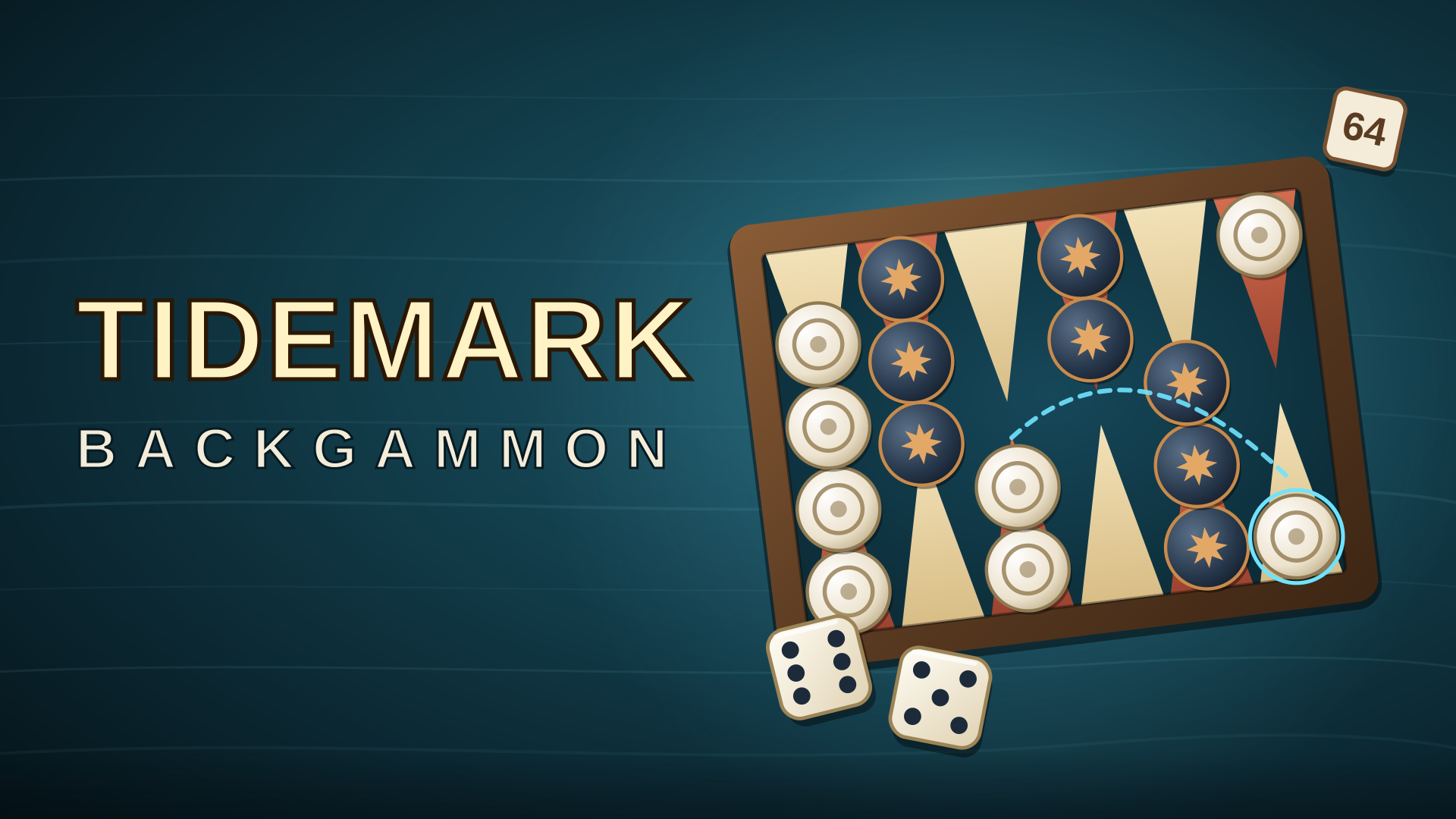
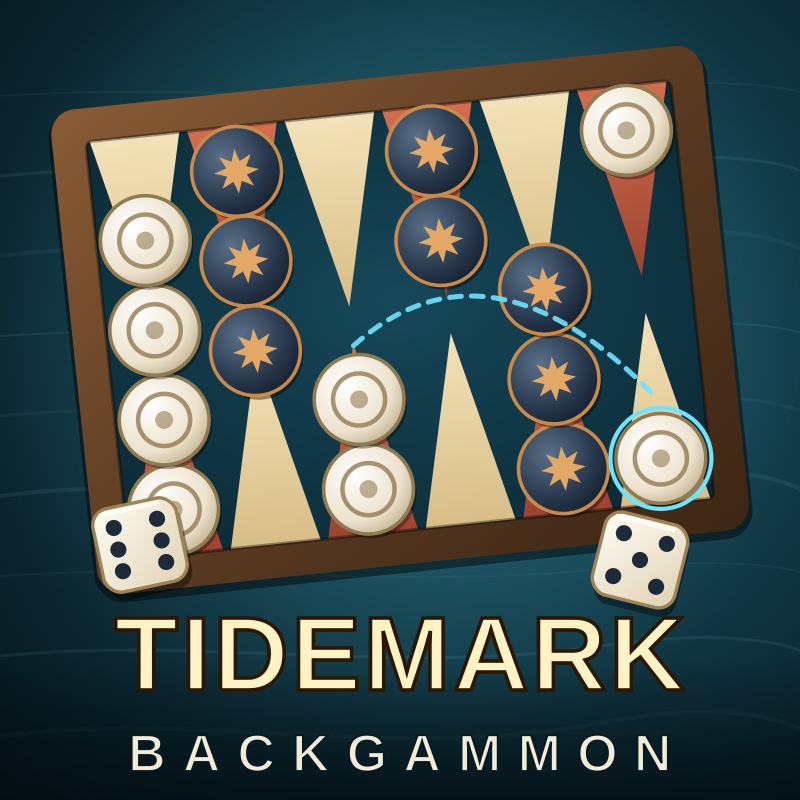
Tidemark Backgammon is the traditional race-and-hit board game with every rule in place. Each player has fifteen checkers. Roll two dice, move your checkers around the board into your home board, then bear them off. The first player to bear off all fifteen wins.
Play against the computer on Easy, Medium, Strong or Expert, or pass the device between two players. Expert looks one full exchange ahead: for each of its best moves it considers all 21 different rolls you could answer with. The computer thinks in the background, so the board stays responsive.
The rules
- Each player starts with two checkers on their 24 point, five on the 13 point, three on the 8 point and five on the 6 point, and moves from higher points to lower ones.
- To start, each player rolls one die. The higher die moves first and plays both numbers; a tie is rolled again.
- Each die moves one checker that many points. A checker may land on an empty point, on its own checkers, or on a single opposing checker (a blot), which is hit and placed on the bar. Two or more checkers block a point.
- Doubles are played four times. You must use both dice whenever you can; if only one die can be played, and either could be, you must play the higher one. With no legal move the turn passes.
- A checker on the bar must enter in the opponent's home board before any other checker moves.
- When all fifteen of your checkers are in your home board you may bear them off: an exact roll takes a checker off its point, and a higher roll takes one off your highest point when no checker sits further back.
- A win is a single game (1 point), a gammon if the loser has borne off nothing (2 points), or a backgammon if the loser also still has a checker on the bar or in the winner's home board (3 points).
Doubling cube and matches
Turn on the doubling cube to raise the stakes: before rolling, a player may double. The opponent either accepts, plays on for twice the points and owns the cube (only they may redouble), or declines and loses the game at the current value. Play single games, or a match to 3, 5 or 7 points. In a match the Crawford rule applies: the game right after a player first comes within one point of winning is played without the cube. Gammons and backgammons always count.
Tips and strategy
- Make points, especially your 5, 4 and 7 points: two checkers together are safe and block your opponent.
- Count before you leave a blot. A checker six points or less in front of an opposing checker is hit far more often than one further away.
- Several made points in a row form a prime that opposing checkers cannot jump; six in a row cannot be passed at all.
- Once the checkers have passed each other the game is a race: compare the pip counts shown beside each player.
- Use a hint when you are unsure. It shows the move the Expert engine would play.
Details
- Technology
- HTML5
- Orientation
- Landscape or portrait
- Languages
- English
- Features
- Saves progress · Works on iPhone and iPad
- Controls
- ←
- ↑
- ↓
- →
- Enter
- Space
- ESC
Tidemark Backgammon features
- Every rule in place. Both dice must be played when possible, the higher die when only one can be, doubles are played four times, a checker on the bar enters first, and gammons and backgammons count 2 and 3 points.
- Four computer levels. Easy and Medium make deliberate mistakes, Strong plays its favourite move, and Expert looks at all 21 rolls you could answer with. The computer thinks in the background, so the board stays smooth.
- Doubling cube. Switch it on to raise the stakes. The computer decides whether to take or drop your double, and you decide about its doubles.
- Match play. Play single games, or a match to 3, 5 or 7 points with the Crawford rule.
- Fair dice. A panel in the menu shows the statistics of every roll in your session, so you can see the dice are not rigged.
- Two players on one device. Share a phone or screen. The board turns to face whoever is on the move.
- Tap, drag or keyboard. Lit points show where a checker can go, and Undo takes back any move of your turn before you confirm.
- Hints and a move list. Ask for the move the Expert level would play, and read back every move of the game.
- Made for every screen. In portrait the board is laid out vertically, and a high-contrast mode is available. Points are listed and moves announced for screen readers.
- Saved games and records. A game or match in progress is saved, and your games, wins, gammons, best streak and matches are kept for every level.
Questions about Tidemark Backgammon
Are the dice fair?
Yes. Every die comes from a random number generator seeded from your browser's secure random source, and a draw that would favour any face is thrown away, so each face has exactly a 1 in 6 chance. The computer gets the same dice as you and never sees a roll in advance. Dice fairness in the menu shows the statistics of every roll in your session.
How strong is the computer?
Easy and Medium make deliberate mistakes, Strong plays the move its evaluation likes best, and Expert also looks at every reply you could roll before choosing. In our test of 200 games, Expert beats Easy about three times out of four.
Why can't I play the move I want?
Backgammon requires you to use both dice whenever possible, and the higher die when only one can be played. A checker on the bar must enter first. Only moves that follow these rules are lit.
How does the doubling cube work?
When the cube is on, the player to roll may double the stakes first. The opponent accepts and owns the cube, or declines and loses the game at its current value. In a match, the Crawford game is played without the cube.
What are a gammon and a backgammon?
If you bear off all your checkers before your opponent has borne off any, you win a gammon, worth 2 points. If they also still have a checker on the bar or in your home board, it is a backgammon, worth 3 points.
Is my game saved?
Yes. A game or match in progress, your settings and your statistics for each level (games, wins, gammons, best winning streak, matches) are saved, and the menu offers to continue where you left off.
Updates
Version 1Live now
Every update passes our automatic build checks before it goes live.
Play on your phone
Point your phone camera at the code to open this game there.